Sunday, July 6, 2025

Sea spaghetti for tea?

Found on the beach: spaghetti! Himanthalia elongata, more commonly known as thongweed or sea spaghetti, is a remarkable brown seaweed that often surprises beachcombers with its long, noodle-like fronds. This species is native to the rocky shores of the northeast Atlantic, from Scandinavia to Portugal, and is especially common around the coasts of Britain and Ireland. It can also be eaten raw or cooked, and is rich in dietary fibre and essential vitamins.


The life-cycle of Himanthalia elongata is both unique and fascinating. It begins as a tiny, olive-green button attached firmly to a rock. This button, only a few centimetres wide, is the vegetative stage and can persist for two to three years. In autumn or winter, the button produces one or more long, strap-like reproductive fronds, which can grow rapidly and reach up to two meters in length by the following summer. These straps, or receptacles, are where reproduction takes place. When mature, the straps become mottled with brown spots, each marking the opening to a reproductive chamber. Gametes are released from June through winter, and after this single reproductive event, the plant dies - a lifecycle known as semelparity or ‘big bang’ reproduction.

The zygotes of Himanthalia elongata are unusually large and heavy for seaweeds, measuring about 0.2 mm across. This size helps them settle quickly onto the substrate, but it also means they are less likely to disperse far from the parent plant. After fertilisation, there is a delay of several days before the young plant develops anchoring structures, and the presence of adult plants nearby can help protect these vulnerable germlings from harsh environmental conditions. For more on this unique seaweed see Wikipedia or The Marine Life Information Network (which is also the source of the photograph below by Paul Newland).

Himanthalia elongata is not just a curiosity for naturalists - it has a range of uses, both traditional and modern. The fronds are edible and have a mild flavour, making them popular in coastal cuisines. They can be eaten raw in salads, boiled, steamed, or even deep-fried, and are sometimes used as a grain-free alternative to pasta. In addition to their culinary uses, the fronds can be dried and powdered to thicken soups and stews, or marinated for use in various dishes.

Nutritionally, sea spaghetti is rich in dietary fibre, antioxidants, vitamins, minerals, and bioactive compounds such as phlorotannins and carotenoids. It has been shown to lower sodium content and improve the nutritional profile of meat products, and is being studied for its potential health benefits, including anti-hyperglycaemic and neuroprotective effects. For more information on this see The National Library of Medicine.

There are several unusual aspects to Himanthalia elongata. For one, it invests almost all its biomass in reproduction, with up to 98 percent of its tissue dedicated to the long, strap-like fronds. The species is also the only member of its genus and family, making it a true oddity among seaweeds. Its large, heavy zygotes are adapted to settle quickly, but this limits their ability to colonise new areas, so populations tend to be quite localised. The fronds can grow at rates of up to 16 mm per day in optimal spring conditions, and the plant’s lifecycle is so tightly linked to environmental cues that the timing of reproduction can vary significantly from place to place.

Saturday, July 5, 2025

Our hopes spin with her

The Argus - 5 July 2125

Brighton Space Centre stands proud on the Brighton seafront this evening, its slender tower catching the reflections in a sky tinged faintly by dust from the Martian frontier. At precisely 23:00, MarsBright - that now-familiar mirrored sphere - launched on its third mission to Mars.

From the beach it seemed to hover impossibly still, balanced atop the old i360 column, now transformed into a humming magnetic launch spine that pierces the skyline like a futuristic needle. The promenade fell silent as countdown lights winked along the tower’s ribs. At the final mark, a deep harmonic vibration rolled through the shingle, rattling faraway deckchairs and drawing startled cries from gulls overhead. Then, with a sudden controlled fury, electromagnetic forces surged through the spine, hurling the pod skyward in a smooth, corkscrewing ascent.

Inside MarsBright, the six-person crew are floating in a stabilised magnetic cradle, insulated from the crushing G-forces that once defined the early days of spaceflight. External cameras are beaming back breathtaking footage of Brighton slipping away in fragmented flashes of myriad lights, of the Palace Pier shrinking to a spindly ghost against the surf, and of the entire coastline curling into a bright seam on the edge of the world before vanishing behind the curvature of Earth.

It was only two decades ago that a handful of newly minted Sussex University physicists, armed with grant money and audacity, discovered the tower’s hollow steel core could be adapted into a vertical electro-magnetic accelerator. Their early tests - pinging lumps of iron skyward at modest velocities - were reported almost as an oddity by this very newspaper, tucked beside stories of seafront bandstands and municipal parking rows. Who then would have imagined that these playful experiments would one day give Brighton a front-row seat in humanity’s reach for the stars?

The city’s first Mars mission in 2115 was a triumph of daring engineering, delivering five astronauts into a fast transit orbit around the red planet and returning them home in a time once thought impossible. By 2121, MarsBright’s second venture established a semi-permanent outpost on Arcadia Planitia, where automated rigs began drilling for ice and testing on-site oxygen production, sketching the first practical outlines of a human habitat.

Now this third expedition will press further still, aiming to lay the groundwork for longer-term habitation - greenhouses seeded with engineered microbes, larger habitats to shield settlers from radiation, and new systems to tap Martian brines for water. MarsBright carries not only fresh crews and equipment, but also the weight of hope from a small seaside city whose name is now quietly etched alongside Houston and Baikonur in the chronicles of exploration.

As the gleaming pod dwindled into the night sky, the launch teams at Brighton Space Centre stood watching in shared, almost reverent silence. Then someone let out a breathless cheer, quickly joined by others, a fragile human sound carried down the wind to the waiting crowds on the beach. Another chapter begins - and as MarsBright spins toward that distant rust-red world, our hopes spin with her. 

Friday, July 4, 2025

Guest: Brighton Beach, North Vancouver

Brighton Beach, tucked discreetly along the rugged western shore of Indian Arm in North Vancouver (Canada), is a boat-access-only enclave that feels worlds removed from the nearby city. This Brighton Beach bears no connection to the old Brighton Hotel or the Hastings Townsite that gave rise to Vancouver’s New Brighton Park. Instead, it is a small, secluded stretch of waterfront lots where dense forest tumbles down to rocky shores, and the only way home is by skiff or water taxi. Here, the community of roughly two dozen properties thrives on the very isolation that would deter most - a haven for those drawn to tranquillity, self-reliance, and the daily rhythms of tide and weather.


Residents who live haul groceries and supplies by boat, navigate steep woodland paths to reach their cabins, and rely on solar panels, rain barrels, and wood stoves. Real estate listings lean into this rugged romance, appealing to artists and adventurous spirits who crave an off-grid life with views of shimmering waters and distant snow-dusted peaks. One cottage, with its modest footprint and sweeping decks, was recently described as perfect for ‘a creative who needs a quiet retreat,’ the sort of place where inspiration might arrive with the morning mist.

Yet the tranquillity here is punctuated by episodes that underscore both the vulnerability and the tenacity of this community. In July 2016, Brighton Beach faced a dramatic trial when a fire broke out, consuming a cottage and a neighbouring home under construction. Firefighters had to be ferried in aboard a Vancouver fire boat, pumping ocean water at astonishing rates while a helicopter hovered overhead, dropping water to stop the flames from reaching the slopes of Mount Seymour. By some miracle and much effort, the fire was contained before it could leap into the forested backbone of the North Shore (see Castanet).

Quirky tales also ripple through Brighton Beach’s recent history. Paddleboarders and kayakers have recounted close encounters with seals and otters, but in 2023, local waters played host to a far grander visitor. A lone orca, soon affectionately nicknamed ‘Indy,’ spent time exploring the entrance to nearby Howe Sound and Indian Arm, thrilling residents who watched from weathered docks and bobbing dinghies. One paddleboarder even found himself eye-to-eye with the orca. (See North Shore News.)

Today, Brighton Beach continues to embody a certain coastal eccentricity. It is a place where stories are exchanged over driftwood railings, where grocery trips are dictated by the tide, and where the vastness of nature presses close on all sides. Unlike its namesake to the south - born of colonial nostalgia for British seaside resorts - this Brighton Beach writes its own narrative, one shaped by cedar, salt air, and the enduring allure of a life perched at the edge of wilderness.

Thursday, July 3, 2025

Burchill on the beach

‘The revamps, the facelifts and the attempts by a clumsy council to write the indigenous Brighton working class out of the upwardly mobile picture are real enough. But on the beach, you get the distinct feeling that Brighton will never completely pull its socks up.’ This is the Brighton treasure Julie Burchill - 66 years old today - writing about the seafront nearly two decades ago.

Born in Bristol in 1959, the daughter of a communist factory worker and a dinner lady, she left home at 17 for London to work at the New Musical Express. She quickly made a name for herself with a brash, slangy style and fierce opinions. Alongside fellow writer Tony Parsons, she helped define the paper’s punk-era voice, becoming a leading figure in a new, confrontational brand of journalism.

In the 1980s Burchill moved from music writing into broader columns and cultural commentary, writing for The Face, The Sunday Times, and The Mail on Sunday. She also spent several years as a star columnist at Cosmopolitan, where her wit and provocations reached a wide female readership. Her work was marked by controversial takes on everything from feminism to class, and she revelled in the notoriety. 

In 1991, Burchill with her husband Cosmo Landesman and Toby Young launched a short-lived magazine, Modern Review, under the slogan ‘Low culture for high brows’. Also in the early 1990s, Burchill relocated to Brighton. She became one of the city’s most talked-about residents, living out her fondness for seaside sleaze, nightlife and scandal. In 2007, she co-wrote Made in Brighton with Daniel Raven, a rollicking blend of personal memoir and city guide, paying tribute to Brighton’s gay culture, drugs scene, and enduring flair for eccentricity. The book can be previewed on Googlebooks. Here is a sample.  

‘Charlotte [Raven, fellow writer on the Modern Review] also called the old neglected seafront ‘a wonderful prompt for human narratives’ - and looking at the pristine Artists Quarter, Fishing Museum and Volleyball Court, where one’s responses are all cued up and ready to go, you could argue that prosperity has been paid for with sheer seedy character. And that this could be a chic, bustling promenade anywhere from Positano to San Francisco, as the beautiful people linger over a latte and plan a hard day’s antique shopping.

But I’m nit-picking. When it still feels like an honour to live somewhere after eleven years, how bad can it be? And it’s still so not London! Beyond the Palace Pier going east towards the Marina, the chill, slick hand of the style police has not yet crushed Brighton’s grand tradition of agreeable, ramshackle blowsiness, and you can still ride the quaint Volks Railway past the abandoned Peter Pan’s Playground and the desperately dated, utterly adorable ‘nudist beach’. Here Little Englander Modernists like me can find the rusty radiance of the resistance to the global village and the Euro-portion which is summed up in the county motto of Sussex: We Won’t Be Druv.

The revamps, the facelifts and the attempts by a clumsy council to write the indigenous Brighton working class out of the upwardly mobile picture are real enough. But on the beach, you get the distinct feeling that Brighton will never completely pull its socks up. Already the white-flight London breeders who came here to create a vast Nappy Valley - a kind of Clapham-on-Sea - are appalled by our unparalleled drug-taking [. . .] and assorted high jinks. Even between the piers, where the gentrification is most obvious and where every citizen should in theory be shopping for hand-painted objets, the vast dope cloud still rises, like a phoenix in reverse, silently and smilingly refusing to be born-again as an on-message, user-friendly unit of the ongoing British economic miracle which has seen us over the past decade come to work the longest hours in Europe - and along the way become one of its most miserable nations. But time passes so quickly in the blameless, shameless sun, on the eternal beach, where the going out and coming in of the ocean makes the only real sense. A working day can be lost forever in the blink of an eye, in forty winks, in a couple of cans of Stella and a cheeky spliff. And a good thing too.

[. . .]

Now I am one of those maddeningly jammy dodgers. I’ve been here in Brighton for twelve years, and the weird thing is that in the best possible way it still doesn’t feel like home. Instead it feels like I somehow got out of going home - time and time and time again - and that I escaped from the life that had been mapped out for me in the landlocked limbo of London; the slo-mo, stressed-out, wound-down fatalism of growing up and growing old. Now that’s lucky, if you like.’

The top photo is accredited to Dan Chung in a 2014 Guardian article. More on Burchill can be found at Wikipedia,

Wednesday, July 2, 2025

West Pier peril

Two young men were hospitalised, yesterday, with serious injuries after falling from the remains of Brighton’s iconic West Pier. Emergency services were called at approximately 12:40 after reports that the pair, who had attempted to climb the structure, had slipped into the sea. Both individuals sustained serious cuts, and one suffered a suspected dislocated shoulder. Lifeguards were able to retrieve them from the water, and they were treated at the scene by the South East Coast Ambulance Service before being taken to hospital for further care. The incident was widely reported, by the BBC, Brighton and Hove News, and on the Sussex Coast Incident News Page.


The incident triggered a large-scale response involving the Shoreham and Newhaven Coastguard teams, Brighton’s RNLI lifeboat, the South East Coast Ambulance Service, and Sussex Police. The rescue coincided with a period of intense heat across the South East, which often draws crowds to the seafront. ‘Climbing on old structures in or over water, tombstoning, or jumping into water from height is dangerous. There’s always a possibility of submerged rocks, metal, or shallow water. Don’t do it. Stay safe,’ HM Coastguard Shoreham warned in a public statement following the incident.


The West Pier, once a Victorian marvel, has been closed to the public since 1975 due to safety concerns. Over the decades, the structure has suffered repeated damage from storms, fires (two suspected arson attacks in 2003), and the relentless effects of the sea. Major collapses have occurred regularly over the last 25 years, each time further reducing the pier’s skeletal remains. The West Pier Trust clearly states the structure is ‘not stable, it is unsafe and liable to collapse,’ and it warns of ‘many sharp obstructions’ on the seabed that are often hidden and could cause serious injury. It urges people to ‘keep away from the structure at all times’ and specifically advises against swimming, surfing, kayaking, paddle-boarding, or sailing near it, as well as never going between the ruin and the yellow marker buoys.’

Generally speaking, this advice is heeded. As far as I can tell, yesterday’s incident was the first of its kind for some good long time, at least the first that has received any publicity (The Palace Pier, however, has been the scene of recent occasional rescues involving the RNLI, see this incident report and another. 

(The photograph immediately above is taken from the Shoreham Coastguard, and the image above it was created by AI.)

Tuesday, July 1, 2025

Happy splashing

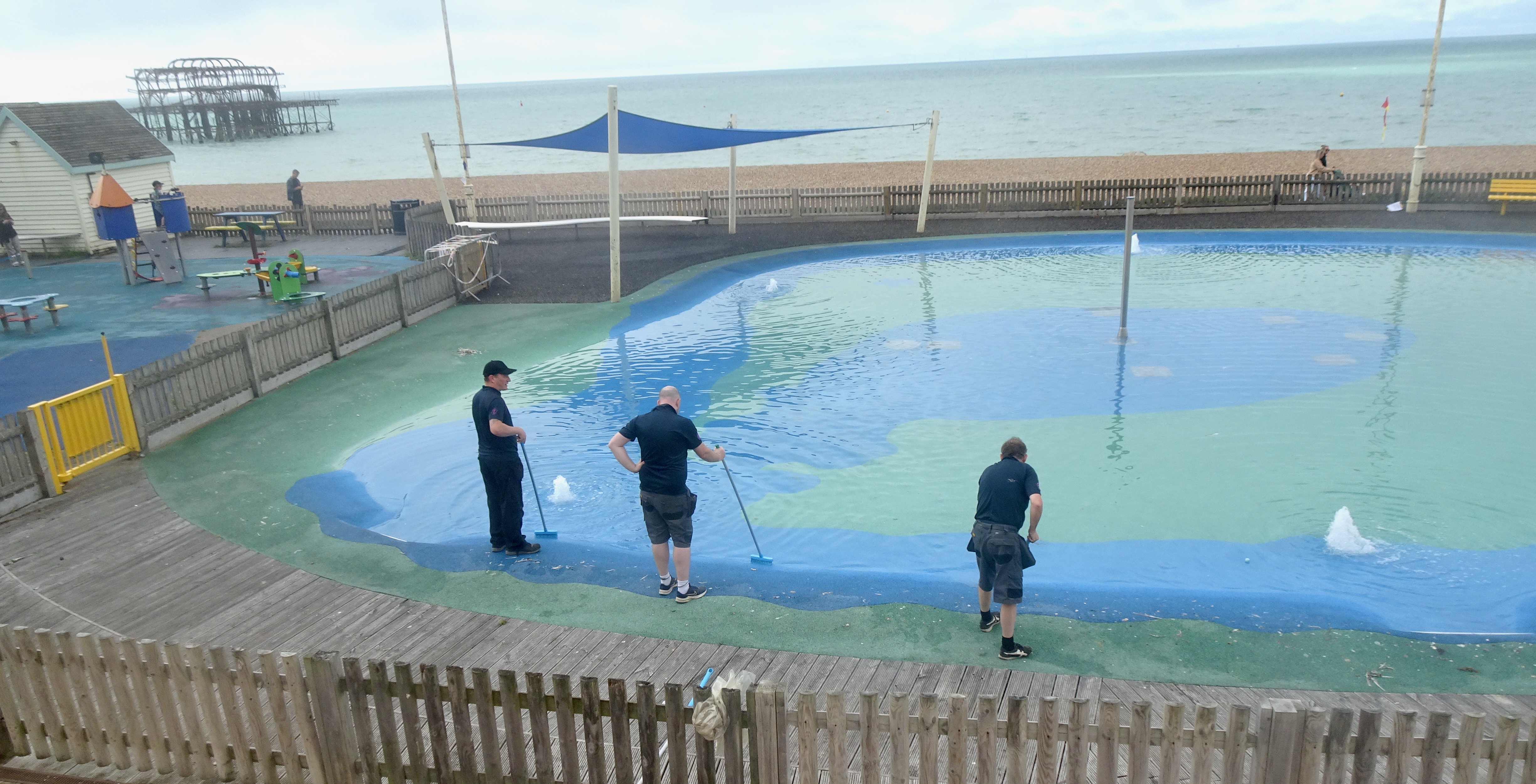
Brighton’s popular Kings Road paddling pool is set to reopen today, 1 July, following weeks of essential repairs that saw the site drained, resurfaced and chemically balanced to ensure safety for thousands of expected summer visitors. According Brighton and Hove Council, the pool, nearby the West Pier, had been closed for work repair on its rubber-crumb flooring and to coordinate with the ongoing maintenance of the nearby A259 arches.


Councillor Alan Robins said the council understood how much families value this facility, calling it ‘a fantastic resource’ that provides ‘somewhere free where families can spend the day, make lifelong memories and, hopefully, enjoy the good weather this summer’. Councillor Trevor Muten added that the city had worked closely with Freedom Leisure, the operator responsible for the pool, to get the site ready in time for the school holidays. Longer term, the council plans to consult local residents on the paddling pool’s future once the arches project is complete.

There has been a seafront paddling pool more or less at this spot for generations. A larger, rectangular paddling pool was built here in the 1950s, just west of the West Pier’s landward remains, roughly opposite Regency Square - this photograph of it was published in The Argus some five years ago without any source or accreditation). When it was demolished either in the late 1970s or early 1980s, the site was repurposed first as tarmac and later partially used for skateboarding. In the early 2000s, as part of wider seafront improvements tied to the new seafront cycle lanes and landscaping, the new circular Kings Road paddling pool was constructed on approximately the same footprint, just slightly adjusted to fit the redesigned seafront layout.

The old paddling pool is fondly remembered, as recorded on the My Brighton and Hove website. Residents have shared stories of learning to swim there as toddlers, recalling sun-warmed concrete, splashes under clear skies, and the happy crush of families seeking relief from the heat. Here is Chris, for example, remembering the late 1960s: ‘’I used to go to the paddling pool with my mum and dad in the mid- to late 60s, before I was ready to “progress” to the sea or the King Alfred. I have vivid memories of the place to this day. I used to put my hands on the bottom and lay forward to “walk” along on my hands, pretending to swim. I also recall the paving around the pool where we’d lay out our towels/blankets and have the drinks and sandwiches we’d brought. Most of all, I remember the water as being wonderfully blue and clean – though with all those toddlers, I imagine it wasn’t quite that pure!’

The modern pool was briefly closed in 2023 after a dead seagull was found floating in the water, prompting a deep clean. Just last year, a spell of very hot weather caused minor surface damage that forced another temporary shutdown. Sporadic vandalism has also led to closures in the past, with glass or debris sometimes thrown into the pool. But now it’s open again, so happy splashing!


Monday, June 30, 2025

41 Places 41 Stories

‘Mark walks the shingle, slowly sweeping his metal detector from side to side listening for the bleep on his headphones? This isn’t his usual haunt. More often he’s down at the Volk’s Railway, where he takes his wife to get out of the flat. His wife’s not very well. She can’t go out on her own any more.’ This is the start of Story 32, about Brighton Beach, in William Shaw’s 41 Places 41 Stories (UnMadeUp, 2007). The small curio of a book was first published as a city-wide installation commission by the 2007 Brighton Festival.


Shaw, who now lives in Brighton, was once a music journalist but, around 2013, he turned - successfully to crime fiction (indeed, he has just published his latest novel - The Red Shore). 41 Places 41 Stories - which can be sampled online at Googlebooks - relates ‘true stories picked up on street corners, taxi ranks, pubs, car parks - even in public toilets’, with each one inhabiting its own geography: a specific place in the centre of a British seaside town. The publisher’s blurb explains; ‘If the essence of narrative is change, William Shaw distils it here in these tales of love, loss and self-discovery. Brighton is, after all, a place where people have always come to transform themselves.’ 

Story 32 is entitled The other day he found a 1966 American silver dollar on the beach. Makes you think, and it has a location subtitle - The beach between the piers. (The photograph above is my own, and has no direct link to Shaw’s book.) Here’s the piece: 

‘Mark walks the shingle, slowly sweeping his metal detector from side to side listening for the bleep on his headphones?

This isn’t his usual haunt. More often he’s down at the Volk’s Railway, where he takes his wife to get out of the flat. His wife’s not very well. She can’t go out on her own any more.

Today, though, his daughter’s down to visit. She’s taken her mother out, so he’s come down here for a change.

He bends down and starts to dig with his trowel. Just under the surface, a shiny 50p piece.

When he was a boy living in First Avenue in Hove, this is where he used to scavenge empty coke bottles for the 3d return money. He would climb up under the West Pier and scour the beams for sixpenny bits that had fallen through the gaps in the boards.

Some make their living down here with metal detectors. At dawn, a half dozen of them will be inching across the stones picking up cash dropped from the pockets of drunken clubbers.

Not Mark. He’s not interested in the money any more. He spent his life going ninety miles an hour. Last couple of years he’s just stopped. For him this is more like archaeology - finding something, wondering how it got there. The other day he found a 1966 American silver dollar on the beach. Makes you think. What’s the story? It’s just a buzz, not knowing what you’re going to pull out. Like fishing.

Tonight he’s cooking sea bass, his favourite. He does all the cooking at home. He is the glue, the one that holds it together.

See those buildings on the seafront? Mark’s been on the roofs of most of them. He used to be a tiler. Working so high up all your life gives you a perspective. Up there, you lose the fear of dying, and with it, your sense of selfishness.

Another noise in his headphones. He reaches down and picks up a rust-crusted penny. That one may have been down there for years.’